How should an advertising budget be split between brand building and sales?
- Home
- blog details
How should an advertising budget be split between brand building and sales?
- Marketinq xəbərləri
- Marketinq strategiyası
- Media planlama
- Brend strategiyası
- TV reklamları
- Çöl reklamları
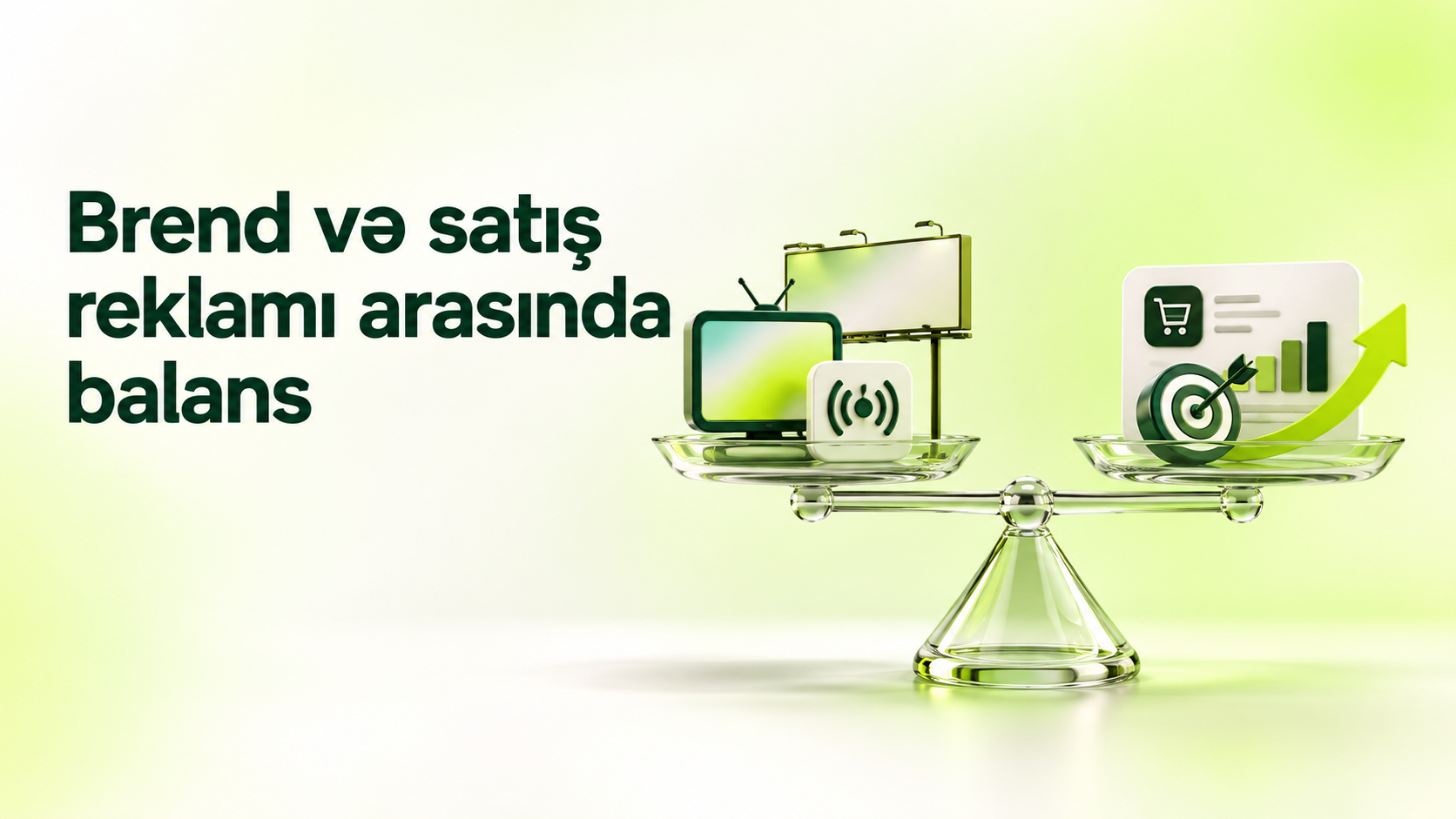
Short answer: putting the entire advertising budget into campaigns designed to generate immediate sales may look efficient, but it can weaken future demand, trust and pricing power. At the same time, image advertising without a measurable path to sales is not a sound strategy. Effective marketing connects brand building and sales activation to the same commercial objective.
How do brand advertising and sales advertising differ?
Sales activation aims to convert existing demand into an enquiry, call, order, store visit or campaign purchase. Search advertising, retargeting, limited-time offers and conversion-led social campaigns can play this role.
Brand building strengthens who the company is, why it should be chosen and how it should feel in the audience's memory. Television, radio, outdoor advertising, broad-reach video, sponsorship and a consistent creative platform can support this task. A channel is not automatically a brand or sales channel; its role is defined by the message, audience, frequency and measurement approach.
Why is a purely short-term view risky?
Performance campaigns often capture demand that already exists. Brand activity helps create future demand, improves the probability of being remembered and makes an offer feel more credible. When a brand is unfamiliar, sales advertising may have to pay more for each new enquiry.
An IPA Effectiveness Databank analysis published on 27 January 2026 covered 812 commercial campaigns. Among campaigns reporting very large increases in brand trust, 93% also reported at least one very large business effect such as sales, market-share or profit growth, compared with 66% across all for-profit campaigns. This is not a universal formula, but it is strong evidence that long-term trust building and commercial performance should not be treated as separate goals.
The 60:40 rule is not a fixed prescription
The IPA analysis observed a 60:40 split between brand and activation among the most effective trust-building campaigns. Applying this number unchanged to every Azerbaijani business would be a mistake. A new market entrant, a mature retailer, a seasonal tourism service and a B2B company require different balances.
The ratio is better used as a starting point for discussion. Category purchase frequency, brand awareness, sales-cycle length, distribution capacity, competitive pressure and the campaign's time horizon should determine the final allocation.
How can TV, radio, outdoor and digital work together?
Broad-reach media can place a brand in the memory of many potential buyers, while digital channels can move interest into research, comparison and enquiry. Television can build narrative and emotion, radio can add frequency, outdoor can reinforce location and recall, and search and social advertising can convert the resulting interest into action.
Nielsen's work on TV and digital campaigns shows that channels can add de-duplicated incremental reach. Simply appearing on several channels, however, is not integration. Audience roles, message sequence, frequency and measurement need to be planned together.
A practical budget framework for Azerbaijan
Separate goals by timeframe: document sales targets for the next 90 days and awareness, trust and market-share objectives for the next 12–24 months.
Measure the starting point: review branded search, direct traffic, spontaneous awareness, price sensitivity, lead quality and sales-cycle length.
Assign a role to every channel: TV and video may provide reach and emotional storytelling, radio frequency, outdoor location and reminders, and digital media demand capture and conversion.
Keep one creative platform: the core idea, visual codes, tone of voice and call to action should not fragment when the channel changes. IPA and System1 research links creative consistency with stronger brand and business effects.
Measure on two levels: track enquiries, sales and acquisition cost in the short term, while monitoring awareness, branded search, market share and margin over time.
Reserve a test budget: allocate a limited share to testing new channels, creative and audiences instead of repeatedly changing the entire plan.
Three common mistakes
First: giving all credit to the last click. A customer may see a TV spot, hear a radio message and later search for the brand; last-click reporting makes the earlier influences invisible.
Second: communicating a different campaign in every channel. The budget is then fragmented across unrelated messages instead of compounding one idea.
Third: treating brand spend as an unmeasurable cost and performance spend as the only source of sales. Both should support growth, but they work across different time horizons and require different measures.
Marketing Partner's approach
Marketing Partner treats media planning as a system for creating demand and converting it into sales, not as a list of channels. Audience, geography, seasonality, creative idea, budget and measurement should be parts of one plan. Through media planning and buying, TV, radio, outdoor and digital roles can be designed within one budget framework, while TV advertising and digital marketing can be linked to the same commercial objective.
The right question is not “Which channel is best?” It is “At the brand's current stage, what job should each channel perform and how should that job connect to the overall sales system?”
Main source: IPA — Trust-building advertising delivers stronger business growth, 27 January 2026. Additional context: IPA/System1 — Creative Consistency and Nielsen — Understanding Campaign Audiences Across TV + Digital. The findings are interpreted as a strategic decision framework, not a fixed norm for Azerbaijan.