Why handcrafted advertising stands out in an AI-saturated feed: lessons from e.l.f. and Prada
- Home
- blog details
Why handcrafted advertising stands out in an AI-saturated feed: lessons from e.l.f. and Prada
- Marketinq xəbərləri
- Brendinq
- Kreativ reklam
- Süni intellekt
- Reklam strategiyası
- Kontent istehsalı
In brief: as generative AI makes advertising production faster, handcrafted work is not automatically better, but it has become rarer and more tangible. e.l.f. Beauty's fully handmade stop-motion holiday campaign, announced on 2 November 2026, and Prada's hand-drawn Holiday 2026 campaign use craft not merely as a visual effect but as evidence of individuality, process and emotional storytelling.
What changed in these campaigns?
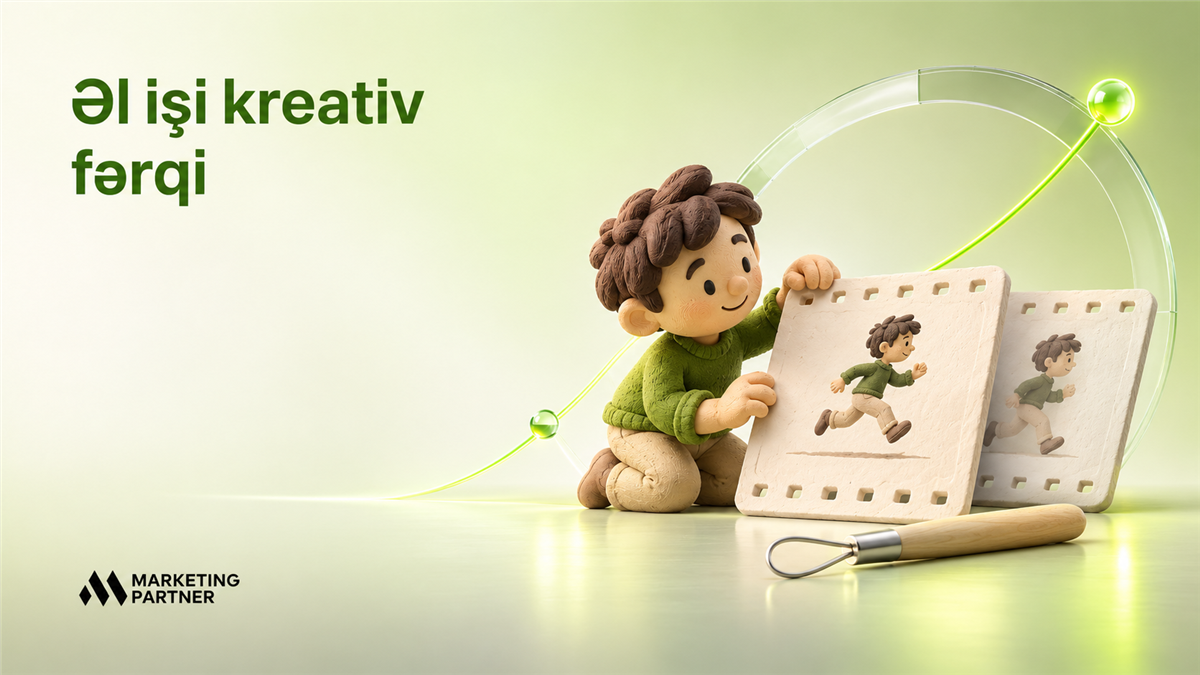
e.l.f. built its first holiday campaign with clay characters, miniature sets and frame-by-frame animation. According to the company's official release, the 60-second film runs across digital and social channels; women made up 90% of the puppet team and 100% of the animation team. The physical world supports a message about treating difference as a strength.
Prada combines live action with illustrations and animation executed entirely by hand under animator John Pomeroy. Its official campaign page describes the work as a celebration of craft and process. A 3 November AdIndex review also points to a wider interest in stop-motion, clay, glass, embroidery and other physical techniques across brands including Levi's and Apple.
Does this mean brands are rejecting AI?
No. e.l.f. does not present the campaign as an anti-AI manifesto, and Prada's official text does not attack generative tools. The claim that brands are abandoning AI oversimplifies the evidence. A more defensible interpretation is that when production tools become widely available, differentiation depends less on technical polish alone and more on a meaningful creative constraint and visible effort.
AI can still support ideation, animatics, versioning, voice tests and adaptation. Physical production adds material texture, a real process and a second layer of behind-the-scenes content. The strategic question is not “human or AI?” but which tool best serves each stage of the brand idea.
When does handcrafted creative work?
- When the technique reinforces the idea: individuality, nostalgia, care and craftsmanship naturally fit physical materials.
- When the process becomes content: sketches, miniature sets and frame-by-frame production create a second story for social media.
- When the difference is visible immediately: texture, slight imperfections and real light can interrupt a generic feed.
- When formats are planned by channel: the main film can run on TV and YouTube, process cuts on Reels and TikTok, and stills in outdoor and display.
A practical Azerbaijan scenario
Hypothetical local FMCG scenario: an Azerbaijani brand such as Azercay or Sirab could build a Novruz or New Year story around a clay miniature world, using familiar table, samovar and family-gathering cues. This is a category example, not a claim about any current campaign by those brands.
The media plan should include more than the final film. “How many frames made one second?”, “How was the miniature table built?” and “How did the first sketch evolve?” can become planned content. TV and outdoor can establish the key image, social media can expand the making-of story, and retail displays can continue the same texture.
Five-step test plan
- Write the brand argument first: explain in one sentence why the technique is right for this product and message.
- Prototype a short scene: compare a 5-8 second handcrafted execution with a more generic digital version before funding the full film.
- Plan the making-of: include process capture in the production schedule and rights agreements.
- Design channel adaptations early: define TV, YouTube, vertical social, outdoor and point-of-sale formats in the brief.
- Measure memory, not views alone: track ad recall, brand association, completed views, branded search and sales signals together.
Risks and critical caveats
Handmade imagery is not a guarantee of originality. If the trend is copied quickly, clay and stop-motion can become another template. Production takes more time and budget, and an expensive technique cannot rescue a weak script. Claims that “no AI was used” also require genuine process transparency.
The technique should follow the idea. If product proof, price or a functional advantage is the priority, craft aesthetics can distract from the message. For emotional positioning, seasonal storytelling and brand-world building, physical production can become a distinctive asset.
Marketing Partner's perspective
In branding and creative development, we do not choose the most fashionable look; we choose the visual system that makes the brand idea clear and memorable. During media planning and buying, we connect the hero film, short social versions, outdoor frames and retail materials so they build the same campaign memory.
Our recommendation is to use AI for speed and variation, and human craft for distinction and proof. Measure not which tool was used, but what the audience felt and how business outcomes changed.
Main source: e.l.f. Beauty — “Made to Stand Out”, 2 November 2026. Campaign example: Prada Holiday 2026 — Drawing Prada. Industry context: AdIndex, 3 November 2026. Public sources do not provide campaign sales results; this article therefore analyses creative strategy without claiming commercial effectiveness.