Can Smart TV advertising drive action? A practical QR interaction plan
- Home
- blog details
Can Smart TV advertising drive action? A practical QR interaction plan
- Marketinq xəbərləri
- TV reklamları
- Smart TV
- Connected TV
- Media planlama
- QR reklam
- Reklam ölçmə
In brief: Smart TV advertising is no longer limited to showing video at scale. A study reported on 3 November 2026 found that 52% of respondents had interacted with Smart TV advertising, with QR codes the most noticed and used element. This does not guarantee the same outcome in Azerbaijan, but it gives local advertisers a useful hypothesis for connecting TV storytelling with measurable digital action.
What did the study find?
In an October 2026 survey of 2,500 Russian adults, 84% viewed interactive Smart TV mechanics positively or neutrally, while 16% reacted negatively. QR codes were the most visible element, mentioned by 31%. Among people with interactive-ad experience, 26% reported scanning a QR code, 17% viewing product cards, 13% requesting more information and 11% taking part in a quiz.
The methodology requires caution: the research was commissioned by an advertising-solutions provider, it covers Russia rather than Azerbaijan, and no Azerbaijani segment is published. The figures should therefore be treated as a test hypothesis, not a local forecast.
Why does the QR mechanic fit television?
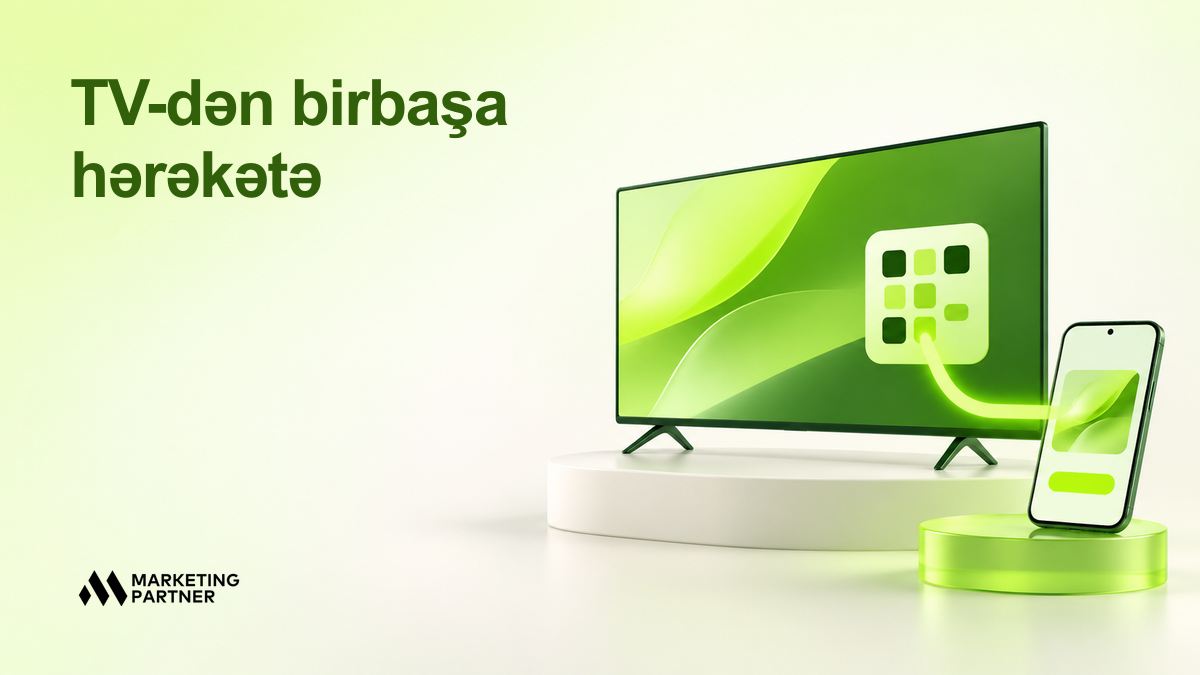
Smart TV is a lean-back screen. Typing or navigating a complex menu with a remote adds friction. A QR code can move viewers to a product page, WhatsApp enquiry, map or campaign form on their phones. Yet the code itself is not a strategy: it needs sufficient screen time, a clear benefit, a fast mobile page and dedicated tracking.
A practical Azerbaijan scenario
Local retail scenario: electronics retailers such as Kontakt Home, Irshad or Baku Electronics could test a Smart TV ad for a new device range with a “compare models and monthly payments” QR journey. This is a category example, not a claim about any current campaign by these brands.
A property developer could link to a virtual tour, an automotive advertiser to a test-drive form, and a supermarket to a mobile coupon. The television story and the mobile next step must carry the same offer and visual language.
Five-step test plan
Choose one action: do not ask the viewer to buy, call, claim a coupon and enter a quiz in one execution.
Build two creative variants: compare the same video with and without the QR mechanic.
Tag the journey: use UTMs, a campaign code and a dedicated landing page to isolate Smart TV traffic.
Shorten the mobile path: show the offer, price or form on the first screen after the scan.
Measure beyond scans: track completed forms, calls, store visits, coupon redemptions and sales.
Which metrics matter?
Reach and frequency describe the media base. QR exposure time and scan rate explain the mechanic; sessions and form completion reveal the mobile experience; sales and incremental lift show business impact. Where possible, use a control geography, time window or audience. A scan is not automatically a sale, and a sale is not automatically caused by the scan.
Marketing Partner's perspective
We do not treat TV advertising as an isolated reach purchase. During media planning and buying, TV, Connected TV, digital video and the mobile conversion point should form one journey with a defined role and KPI for every channel. When creative, placement and measurement are designed together, the largest screen can build both brand value and measurable demand.
Our recommendation is to begin with a controlled pilot and scale only after business outcomes—not QR scans alone—are demonstrated.
Main source: AdIndex — MTS Ads Premium Video Smart TV study, 3 November 2026. The survey covered 2,500 adults in Russia in October 2026. International context: Amazon Ads and Publicis Media research on interactive video. The figures are not projected directly onto Azerbaijan.